

Check Run Agents are in beta. Contact support@macroscope.com to get access.
Getting Started
- Create a
.mdfile in.macroscope/check-run-agents/in your repo root (e.g..macroscope/check-run-agents/web-review.md) - Configure the frontmatter fields you need (all optional) and write your instructions:
- Commit and push to your default branch.
Macroscope reads check run agent files from your default branch. Changes won’t take effect on new PRs until they’re merged.
Scope and Organization
Each.md file in .macroscope/check-run-agents/ becomes its own agent, scoped to the repo it lives in. We recommend starting with one file and splitting only when you need different configurations (e.g. different tools or input modes).
A typical repo structure:
Existing setup? If your check run agent files are in
.macroscope/ instead of .macroscope/check-run-agents/, they will continue to work. We recommend moving them to the subfolder when convenient — the root location will stop being read in a future release. See Migrating to the subfolder for a one-line move.CLAUDE.md to guide how AI writes code, you can reference it from your check run agent’s instructions to keep coding conventions and review standards in sync.
File Format
The file has two parts: an optional YAML frontmatter block for settings and a markdown body with your instructions. Every frontmatter field is optional. If you omit frontmatter entirely, defaults apply and the filename becomes the title.| Field | Default | Options | Description |
|---|---|---|---|
title | Derived from filename | Any string (max 60 chars) | Name in GitHub Checks UI |
model | claude-opus-4-6 | claude-opus-4-5, claude-opus-4-6, gpt-5-2 | Which model powers the agent |
reasoning | low | off, low, medium, high | Extended thinking depth |
effort | low | low, medium, high | How deep the agent digs |
input | full_diff | full_diff, code_object | How the PR diff is fed to the agent |
tools | [browse_code, git_tools, github_api_read_only, modify_pr] | See Tools | Which tools the agent can use |
include | none | Glob patterns | Only review files matching these patterns (e.g. "*.go", "src/**") |
exclude | none | Glob patterns | Files to skip (e.g. "*.lock", "vendor/**") |
conclusion | neutral | neutral, failure | Maximum severity the agent can report |
include and exclude: Scoping by File
Use include to review only files matching your patterns, or exclude to skip files you don’t care about.
| Configuration | Behavior |
|---|---|
| Neither set | All changed files are reviewed |
Only include | Only files matching at least one pattern are reviewed |
Only exclude | All files except those matching a pattern are reviewed |
| Both set | include wins — exclude is ignored (a configuration warning is emitted) |
"*.go", "src/**", "services/auth/**/*.go", etc.
.macroscope/ignore: Repository-Wide Exclusions
To exclude files from all check runs at once — not just a single agent — add patterns to your repository’s .macroscope/ignore file. These patterns are additive with include/exclude: a file is out of scope if it matches either the agent’s front matter patterns or the repository-wide ignore patterns.
How filtering behaves when every changed file is excluded:
| Filtering source | Behavior |
|---|---|
include / exclude only | Check run is not created (invisible in Checks tab) |
.macroscope/ignore only | Check run is created but skipped (visible in Checks tab) |
| Both combined | Check run is created but skipped |
- In
full_diffmode, the agent sees the entire PR diff for context. It is instructed to respectinclude/excludeand.macroscope/ignorepatterns when posting comments or reporting issues — it won’t flag out-of-scope files unless your instructions explicitly override this. - In
code_objectmode, out-of-scope code objects are filtered out before the agent runs — the agent never sees them.
input: Full Diff vs Code Object
| Mode | What happens | When to use | Cost |
|---|---|---|---|
full_diff (default) | One agent processes the entire PR diff | Enforcement that needs PR-level context (“new function added without tests”) | Lower |
code_object | Up to 20 agents in parallel, one per changed code object | Per-unit enforcement (“don’t log PII in any changed file”) | Higher |
conclusion: Blocking vs Non-Blocking
By default, the conclusion is capped at neutral: issues show up in the Checks tab but never block merging. Set conclusion: failure to let the agent block PRs when it finds issues.
Even with failure, the check still reports success when nothing is wrong. The setting only raises the ceiling on severity, not the floor.
See
.macroscope/ignore: Repository-Wide Exclusions for details on how include/exclude and .macroscope/ignore interact when all files are filtered out.Tools
Included by Default
| Tool | What it does |
|---|---|
browse_code | Explore the file tree, read files, search by filename or content |
git_tools | Git log, blame, diff, grep |
github_api_read_only | Read-only GitHub API: issues, labels, PR metadata, commit statuses |
modify_pr | Update the PR (title, description, labels, assignees, reviewers) and post line-level review comments |
Specifying
tools: in frontmatter overrides the defaults. To keep defaults and add more, list them all.Additional Tools
| Tool | Requires | What it does |
|---|---|---|
web_tools | No connection needed | Search the web, fetch URLs |
slack | Slack connected | Post messages to channels, look up users |
sentry | Sentry connected | Search error issues, view event history |
posthog | PostHog connected | Query analytics, feature flags, session recordings |
launchdarkly | LaunchDarkly connected | Query feature flags, targeting rules |
bigquery | BigQuery connected | Run read-only SQL queries |
amplitude | Amplitude connected | Event segmentation, funnels, retention |
gcp_cloud_logging | GCP connected | Query log entries by severity, resource, timestamp |
issue_tracking_tools | Jira or Linear connected | Read issues and projects |
image_gen | No connection needed | Generate images from text prompts and upload them to GitHub or Slack |
mcp | MCP server connected | Invoke tools from any connected MCP server |
Connected tools require the integration in Settings > Connections. Missing connections are silently disabled.
Output and Instructions
Where Results Appear
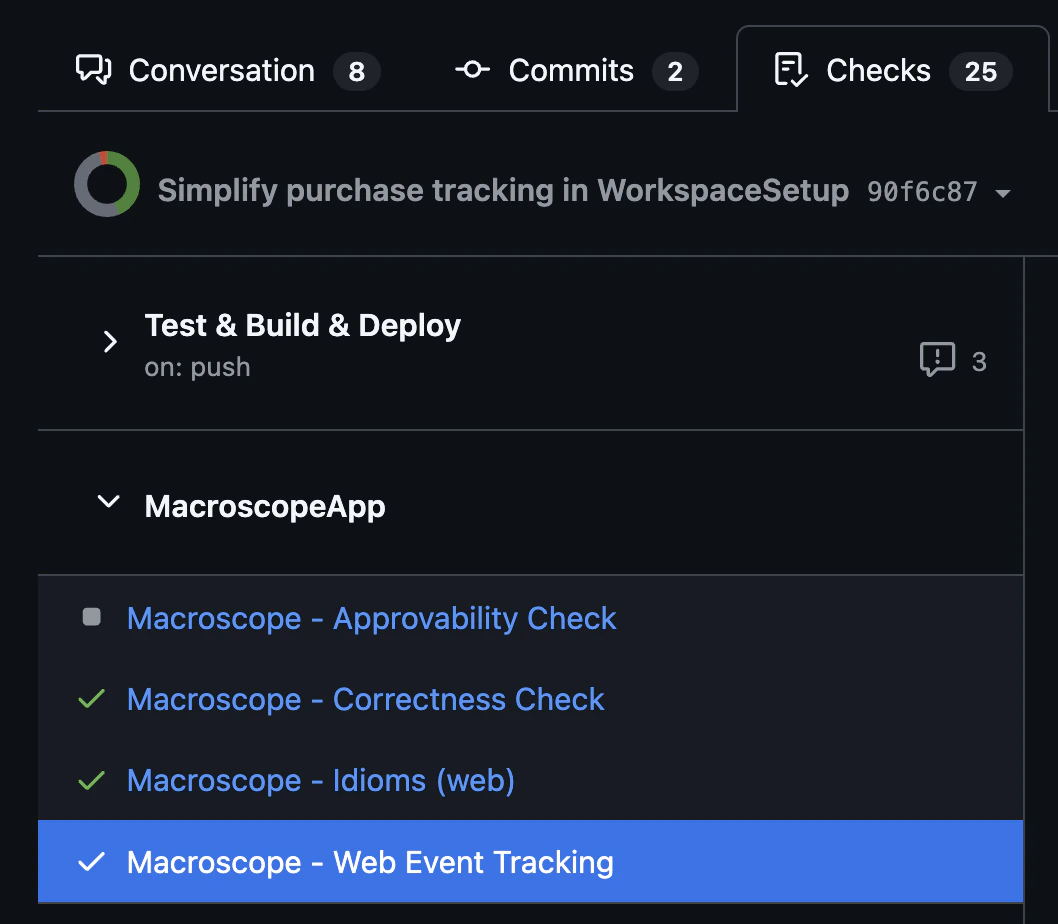
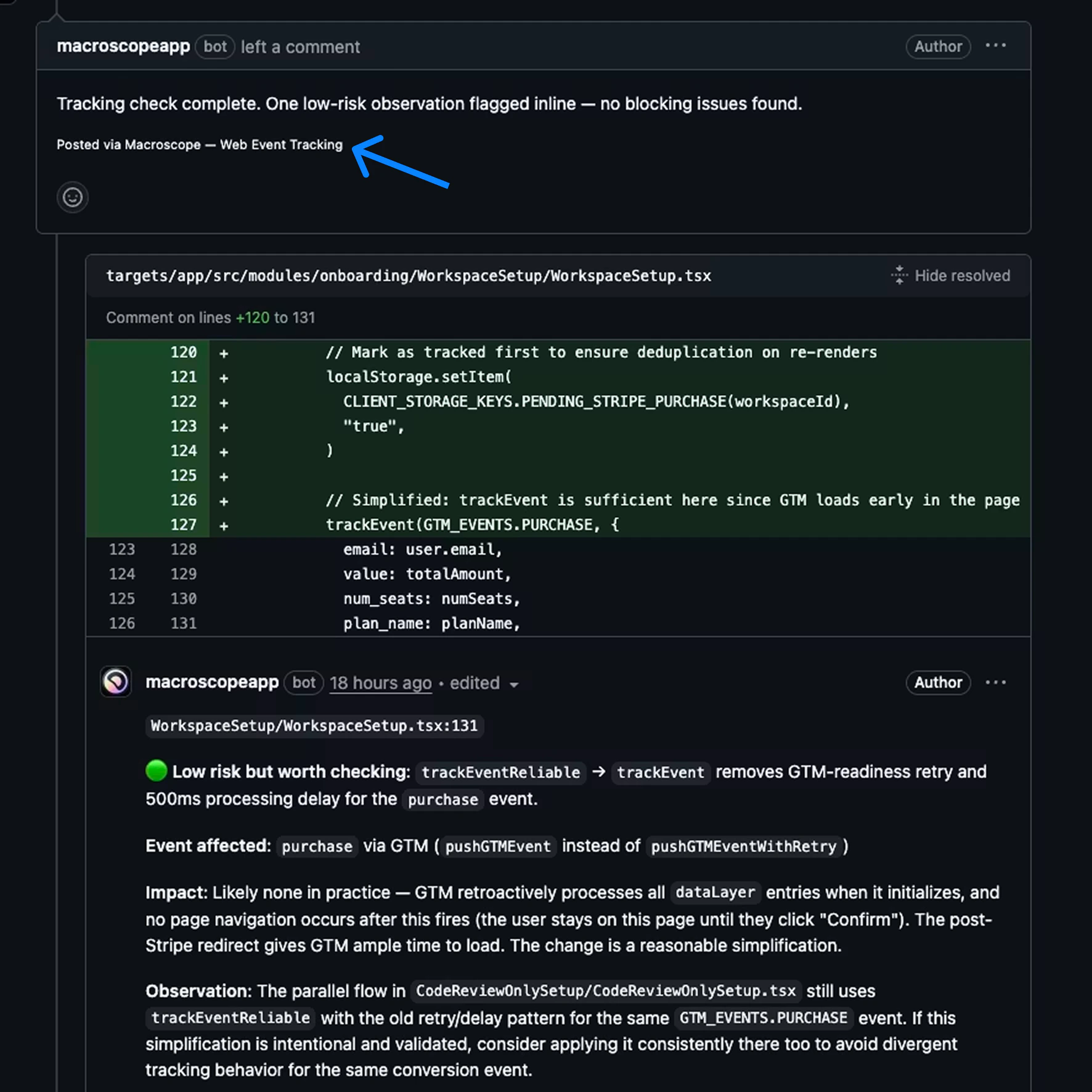
Results appear in three places:- Check run details. Click into the check in the Checks tab to see the full report: title, summary, and detailed findings. Your instructions influence how this output is structured and formatted.
- Inline PR comments. The agent posts comments directly on specific lines in the PR diff, attributed to the check name.
- Issue comments. The agent can also post top-level comments on the PR itself for broader findings or summaries.
Controlling Output Format
You can control formatting in your instructions. Some examples:- “Use a markdown table with columns: file, line, issue, severity”
- “Group findings by priority, critical first”
- “Use 🔴 🟡 🟢 emoji for severity levels”
- “Start with a one-line summary, then list details”
- “If no issues found, just say ‘All clear’ with no extra detail”
- “Format as a checklist so the reviewer can tick items off”
- “Be concise. Each bullet point should be under 20 words”
Writing Good Instructions
- Be specific. “Review for quality” is too vague. “Flag any function over 50 lines without a doc comment” is actionable.
- Define severity. Spell out what critical vs minor means for your team.
- Don’t replicate the Correctness check run. It already catches runtime bugs. Focus on your team’s conventions and workflows.
- Scope with
includeorexclude. If your check only applies to Go files, useinclude: ["*.go"]. If it applies to everything except lock files, useexclude: ["*.lock"]. - Give the agent permission to do nothing. “If nothing applies, report that no issues were found” prevents invented findings.
- Use sections in your instructions. Markdown headings (
##) in the body help the agent organize its work and output. - Reference specific paths. “Check files in
services/auth/” is better than “check auth code.” - Tell it what not to flag. “Ignore test files” or “don’t flag TODOs in draft PRs” reduces noise.
Example
We recommend consolidating related rules into a single check rather than splitting across many files. Here’s a web team example that handles several concerns in one agent — saved as.macroscope/check-run-agents/web-review.md:
Migrating to the Subfolder
If you have check run agent files in the root.macroscope/ directory, move them into the check-run-agents/ subfolder:
approvability.md and ignore are not check run agent files — leave them in the .macroscope/ root.
Migrating from Custom Rules
Check Run Agents replace Custom Rules. If you have an existingmacroscope.md file, move your rules into .macroscope/check-run-agents/my-rules.md instead. Your existing rules become the instructions body, and you can optionally add frontmatter for model, tools, and input mode.
Check Run Agents go further: agents can browse the codebase, query git history, post to Slack, check Sentry, and more. You also get structured output in the Checks tab instead of just inline comments.
Billing
Check Run Agents are free during beta. We will announce pricing changes in advance.
include/exclude or .macroscope/ignore to scope to relevant files, prefer full_diff over code_object, and use lower effort for simple checks.